

Co-regulation is the process by which one nervous system influences and stabilizes another — through breath, voice, face, posture and touch, below the level of conscious strategy. Most explanations stop there, at co-regulation as comfort. This one goes further, because co-regulation of the nervous system is not primarily about feeling soothed. It is the condition under which an old pattern can physically be rewritten. Those are different claims, and the difference is why you have understood your patterns for years without them moving.
The thing self-regulation cannot do
You have probably been handed the standard sequence: regulate yourself first, then bring your regulated self to your relationships. Breathwork, cold exposure, journaling, meditation — build the skill alone, deploy it socially.
The sequence is backward, and it is backward for a developmental reason. Self-regulation is not a primary capacity. It is a residue of co-regulation. An infant’s prefrontal cortex will not approach maturity until the mid-twenties; in the meantime, arousal is managed almost entirely by an attuned adult, and the child’s eventual capacity to self-soothe is built out of thousands of repetitions of being soothed by someone else.
You did not learn to regulate and then learn to relate. You were regulated by others until enough of it was internalized to run offline. Where those repetitions were missing, inconsistent, or frightening, the internalized version is missing too — and no quantity of solo protocol fully substitutes for the input that was supposed to build it.
Being with someone changes what your brain does under threat
This is measurable, and the measurement is unusually clean.
Coan, Schaefer, and Davidson placed married women in an fMRI scanner under threat of electric shock, in three conditions: holding their husband’s hand, holding an anonymous experimenter’s hand, or holding no hand at all. Spousal hand-holding produced a pervasive attenuation of activation across the neural systems supporting threat response. A stranger’s hand produced a smaller attenuation. And critically, the size of the effect varied with marital quality — higher relationship quality predicted less threat-related activation in the right anterior insula, superior frontal gyrus, and hypothalamus during spousal hand-holding specifically. [1]

The mechanism is not “touch is nice.” It is that the brain appears to treat a trusted other as a resource it can offload onto — running a cheaper threat calculation when support is genuinely available. Coan and Sbarra later formalized this as Social Baseline Theory: the human brain expects access to relationships that lower risk and reduce the effort required to meet goals, in part by folding relational partners into the neural representation of the self. Losing access to those partners increases cognitive and physiological effort. [2]
Read that as an economic claim, because that is what it is. Solitude is not neutral. It is expensive. Being alone with a threat is a metabolically costlier way to be alive, and your body has been paying that bill.
The bill comes due physiologically
This is not confined to a scanner.
Married partners show synchronized cortisol across the day — measured by repeated saliva sampling, one partner’s level tracks the other’s, and marital satisfaction moderates how strongly negative mood transfers between them. [3] Intranasally administered oxytocin increases positive communication behavior during couple conflict and significantly reduces salivary cortisol afterward compared to placebo. [4]
And at the population scale, the meta-analytic picture is blunt: across 148 studies and 308,849 participants, stronger social relationships were associated with a 50% increased likelihood of survival (OR = 1.50, 95% CI 1.42–1.59). The association was strongest for complex measures of social integration (OR = 1.91) and weakest — in fact non-significant — for crude indicators like living alone versus with others (OR = 1.19). [5]
That last detail matters more than the headline. Proximity is not the active ingredient. Integration is. You can live with someone and get nothing. This is the difference between a housemate and a nervous system.
Now the part that explains why insight has failed you
Everything above establishes that co-regulation makes a body feel safer. It does not yet explain why safety should change anything permanently. People are soothed constantly and hold the same beliefs for decades.
The missing mechanism is memory reconsolidation.
The old model said memory consolidates once and then only decays. Nader, Schafe, and LeDoux overturned it: a consolidated fear memory, when reactivated by retrieval, returns to a labile state requiring new protein synthesis to re-stabilize. Infuse a protein synthesis inhibitor into the amygdala shortly after reactivation, and the memory is absent on later tests — at one day or fourteen days post-conditioning. The same infusion without reactivation leaves it intact. Delay it six hours, and it leaves it intact. [6]
Retrieval opens a time-limited window in which a stored emotional memory is physically re-writable. Then it shuts.
Monfils and colleagues showed the therapeutic version: an isolated retrieval trial before an extinction session — putting the new learning inside the window instead of outside it — permanently attenuated fear in rats, without drugs, where ordinary extinction was not permanent. [7] Schiller and colleagues replicated the principle in humans: fear memories updated with non-fearful information inside the reconsolidation window ceased to be expressed, held for at least a year, and the effect was selective to reactivated memories only. [8]
The two conditions, and why they need another person
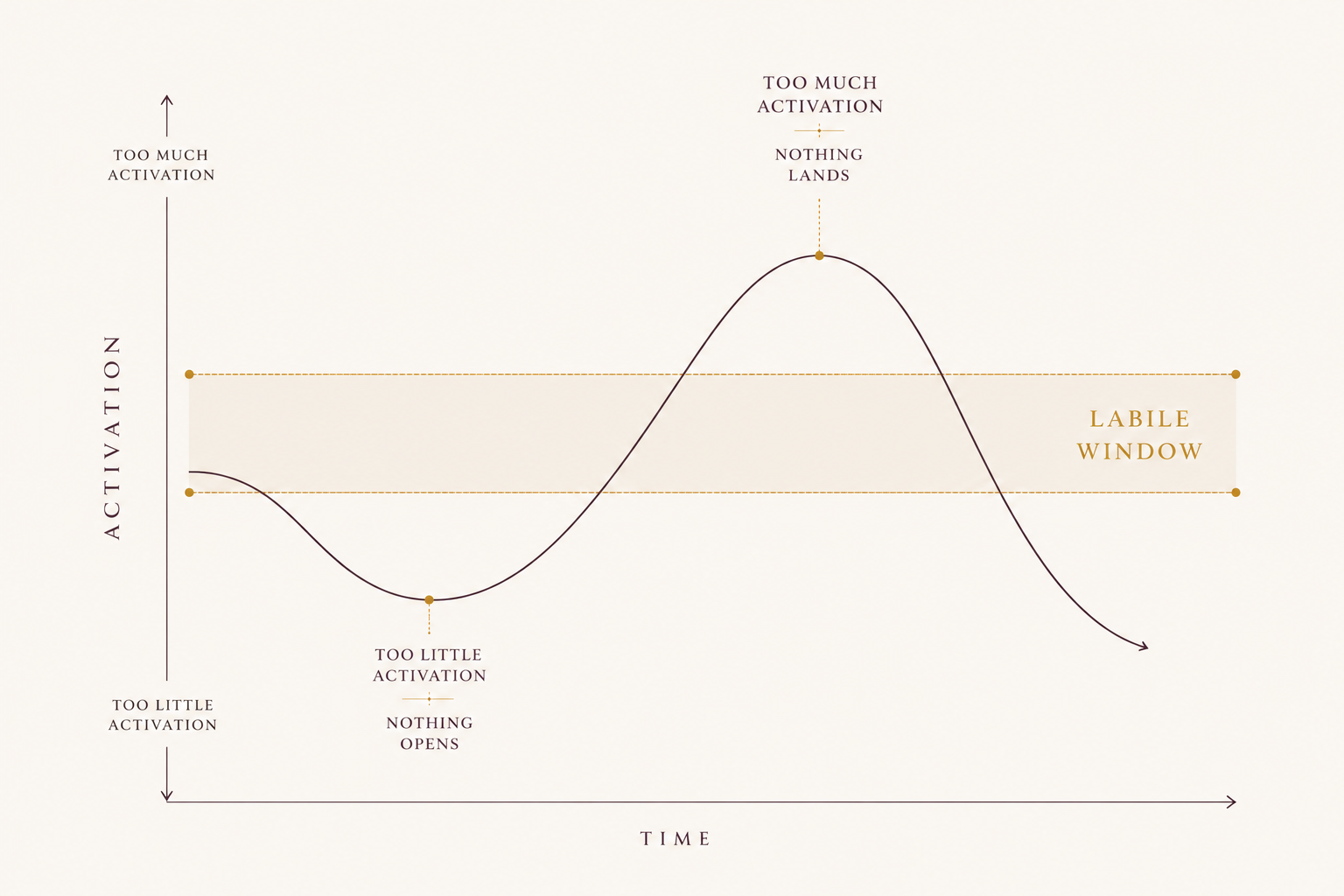
Reconsolidation requires two things simultaneously:
- Activation. The old memory must be genuinely reactivated — felt, not narrated.
- Mismatch. New, contradicting information must arrive while it is labile.
Miss either and nothing updates.
- Talk about it from a safe distance → no activation → nothing is soft → nothing changes. This is most therapy that consists of explaining yourself, and it is why you can describe your pattern fluently and still live inside it.
- Get flooded by it alone → activation, no mismatch → the only information present is the original information: no one comes; I do this by myself. The window closes on the same prediction, reinforced.
Which produces the single most useful sentence in this article:
Retrieval without repair is not processing. It is rehearsal.
A regulated other holds the narrow band where both conditions are met at once — activated enough to be labile, safe enough to encode something new. That is the actual job. Not comfort. Not advice. Condition-setting for neuroplastic change.
Boundary conditions — stated honestly
Reconsolidation is the best current mechanistic account, not a settled law. Its boundary conditions — memory age, memory strength, and whether genuine prediction error is present at retrieval — are actively debated. Human replications of the Schiller paradigm have been mixed. And the animal work is amygdala-dependent cued fear conditioning, which is not the same thing as autobiographical relational memory in a 40-year-old.
Anyone selling you reconsolidation as a guaranteed protocol is overselling. What it does give you is a coherent explanation for something clinicians observe constantly: that decades can reorganize inside twenty minutes, and that it happens in the presence of another person rather than alone with a notebook.
What this changes about how you look for help
Three practical consequences.
A practitioner can only hold you to the depth they have gone themselves. The instrument is their nervous system. An unregulated one cannot hold the band — it either avoids the activation or gets recruited into it. This is why ongoing personal work is not a nice credential for a therapist. It is the equipment.
“Regulate yourself first” is the wrong order. You borrow a baseline before you own one. If you have been waiting until you are regulated enough to ask for support, you have the sequence inverted, and it will not resolve on its own.
Proximity to a dysregulated group still lowers your threat load in the short term. This is the uncomfortable one, and it explains something that otherwise looks like weakness. Co-regulation does not check whether the container is good for you. A community that is harming you can still be regulating you — which is why leaving one produces something closer to withdrawal than to sadness, and why people stay far past the point of evidence. That is not a character failure. That is a nervous system correctly reporting that it is about to pay more.
Where to start
If you want to test any of this, do not start by trying harder alone. Start in a room with someone whose job is to hold the band.
The Window is 90 minutes, one-to-one, and it is built precisely on this: activation held safely enough that the meaning underneath can surface and be met with something other than what met it the first time. Book The Window.
FAQ
What is co-regulation of the nervous system?
Co-regulation is the bidirectional process by which one person’s nervous system influences and stabilizes another’s, via breath, vocal prosody, facial expression, posture, and touch. It operates below conscious strategy and is the mechanism through which infants develop self-regulation — and through which adults continue to maintain physiological balance.
Is co-regulation the same as being comforted?
No. Comfort lowers arousal. Co-regulation, in a therapeutic context, holds a person in a specific band — activated enough that an old emotional memory is labile, safe enough that new information can be encoded. That band is where change becomes biologically possible.
Why hasn’t understanding my pattern changed it?
Because insight satisfies only one of the two conditions required for a memory to update. The memory also has to be genuinely reactivated — felt — at the moment the new information arrives. Understanding a pattern from a calm distance leaves nothing labile to rewrite.
Can I co-regulate by myself?
You can raise your own vagal tone with breath, humming, cold exposure and movement, and that is worth doing — it builds the physiological capacity. But the specific band required for reconsolidation is very difficult to hold alone, because alone-ness is frequently the original information the memory is encoding.
How long does the reconsolidation window last?
In the animal work, protein synthesis inhibition produced amnesia when delivered shortly after reactivation but not when delayed six hours, implying a window of a few hours. Human autobiographical equivalents are not precisely established, which is why claims of an exact duration should be treated with caution.
Does this mean my relationships are making me ill?
It means relationship quality is a physiological variable, not only an emotional one. Cortisol synchronizes between partners, and relationship quality moderates how strongly stress transfers. Chronically dysregulating relationships impose a measurable load; well-integrated ones measurably lower it.
References
(1) Coan, J. A.; Schaefer, H. S.; Davidson, R. J. Psychol. Sci. 2006, 17 (12), 1032–1039. DOI: 10.1111/j.1467-9280.2006.01832.x.
(2) Coan, J. A.; Sbarra, D. A. Curr. Opin. Psychol. 2015, 1, 87–91. DOI: 10.1016/j.copsyc.2014.12.021.
(3) Saxbe, D. E.; Repetti, R. L. J. Pers. Soc. Psychol. 2010, 98 (1), 92–103. DOI: 10.1037/a0016959.
(4) Ditzen, B.; Schaer, M.; Gabriel, B.; Bodenmann, G.; Ehlert, U.; Heinrichs, M. Biol. Psychiatry 2009, 65 (9), 728–731. DOI: 10.1016/j.biopsych.2008.10.011.
(5) Holt-Lunstad, J.; Smith, T. B.; Layton, J. B. PLoS Med. 2010, 7 (7), e1000316. DOI: 10.1371/journal.pmed.1000316.
(6) Nader, K.; Schafe, G. E.; LeDoux, J. E. Nature 2000, 406 (6797), 722–726. DOI: 10.1038/35021052.
(7) Monfils, M.-H.; Cowansage, K. K.; Klann, E.; LeDoux, J. E. Science 2009, 324 (5929), 951–955. DOI: 10.1126/science.1167975.
(8) Schiller, D.; Monfils, M.-H.; Raio, C. M.; Johnson, D. C.; LeDoux, J. E.; Phelps, E. A. Nature 2010, 463 (7277), 49–53. DOI: 10.1038/nature08637.
