
If you have taken psilocybin, LSD, ayahuasca or MDMA more than once, you may have noticed that the same dose does not reliably produce the same experience. Sometimes the difference is obvious — set, setting, sleep, what happened that week. Sometimes it isn’t, and you are left with a variation you cannot account for.
If you menstruate, there is a candidate explanation that almost nobody will raise with you, including most of the people guiding these experiences.
The short answer
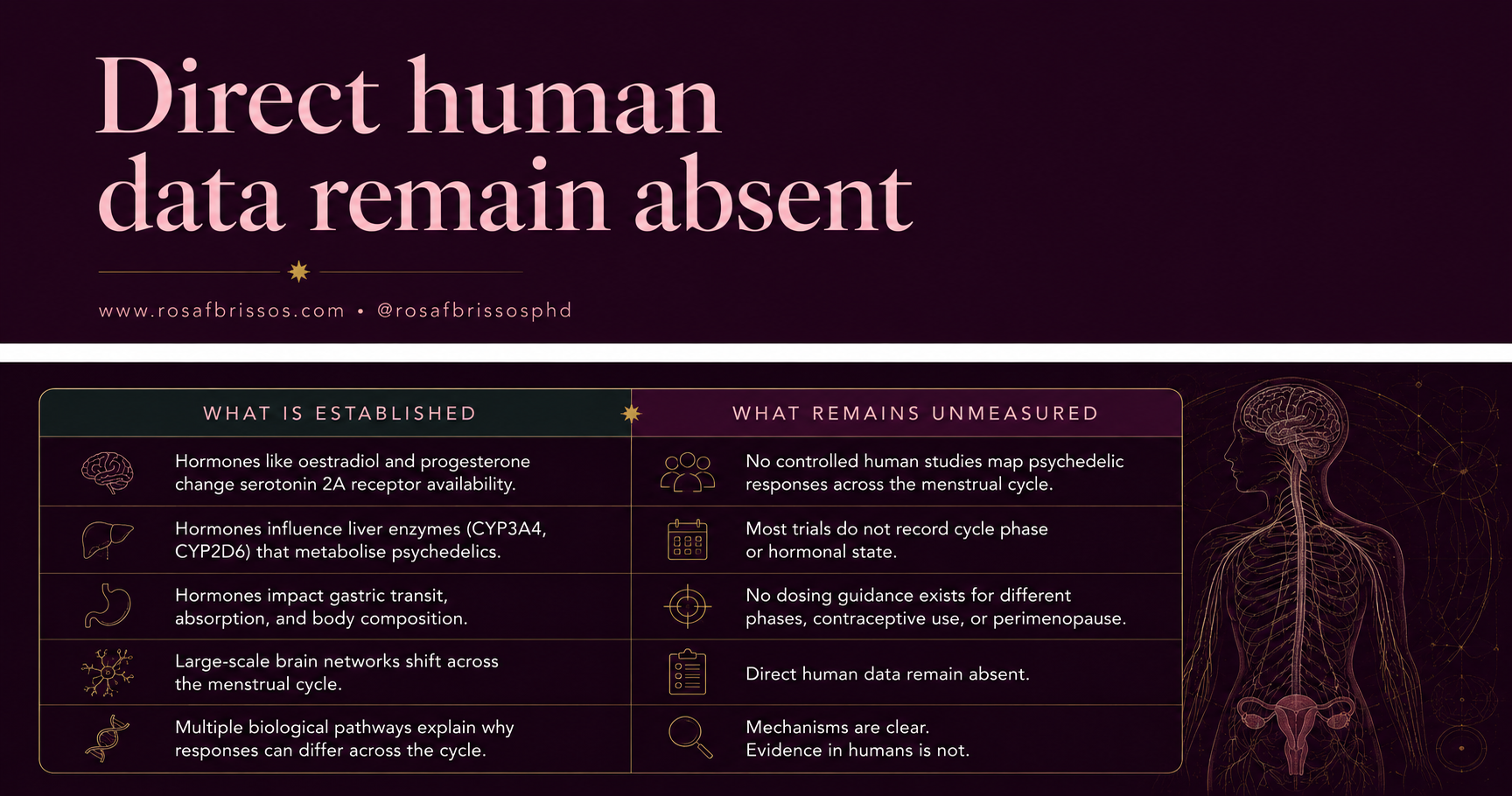
Your hormonal state almost certainly changes how psychedelics land in your body. The mechanism is well characterised, and the reasoning is not speculative.
And nobody has measured it properly.
Not “the findings are mixed.” Not “it’s debated.” The direct human data does not exist. Two major reviews published within two years of each other reached the same conclusion independently, and I will show you both.
That gap is the actual subject of this article, because it changes what you should do with the information. If you were hoping for a chart telling you which day to book — that chart is not available, and anyone selling you one built it from a mechanism and filled in the confident part themselves.
What you get instead is narrower and, I think, more useful.
Why nobody measured this
The exclusion of female bodies from this research did not begin with psychedelics. It is inherited.
In 2010, Annaliese Beery and Irving Zucker published an audit in Neuroscience & Biobehavioral Reviews examining sex bias across ten fields of mammalian research (1). Male bias appeared in eight of them. It was worst in neuroscience, where single-sex studies of male animals outnumbered studies of females 5.5 to one.
They also recorded the justification the field had given for this. Female mammals were held to be intrinsically more variable than males — the cycle introduced fluctuation, fluctuation introduced noise — and were therefore, in the language of the literature, too troublesome for routine inclusion in research protocols.
Then Beery and Zucker tested that assumption.
It does not hold. Their conclusion, in their own words, is that the belief is without foundation (1).
I want to sit on that for a moment, because it is easy to read as a historical curiosity, and it is not one. An entire evidence base was constructed on the premise that the female body was a methodological inconvenience. Not a different physiology requiring study — an inconvenience. And the premise was never checked until decades of data had already been built on it.
The regulatory history runs alongside. Women of childbearing potential were formally excluded from early-phase drug trials from the late 1970s, a decision made in the wake of thalidomide and defensible on its own terms at the time. It was not meaningfully reversed for the phases where foundational pharmacokinetic data is established. Dosing, timing and safety thresholds were determined in bodies that do not cycle — and then applied to bodies that do.
What the exclusion actually cost
This is where it stops being an academic complaint.
In 2020, Zucker and Brian Prendergast examined the pharmacokinetic data for 86 approved drugs (2). For 76 of them, women showed higher blood concentrations and slower elimination than men at the same dose. Where those drugs had clinically identifiable adverse reactions, the sex-biased pharmacokinetics predicted the direction of the sex-biased harm in 88% of cases.
Women experience adverse drug reactions nearly twice as often as men (2).
The obvious objection is that women are on average smaller, and this is simply a dose-per-kilogram artefact. It is worth raising because it is the first thing most clinicians say. Zucker and Prendergast checked it. The effect was not explained by differences in body weight (2).
It is absorption, distribution, metabolism and clearance — a genuinely different pharmacology, dosed as though it were the same one. Their recommended remedy is almost boring: evidence-based dose reductions for women.
That is the price of “too troublesome.”
What your hormones do to the system psychedelics act on
Classical psychedelics — psilocybin, LSD, DMT, mescaline — act principally as partial agonists at the 5-HT2A serotonin receptor. That is the primary target, and it is not seriously contested.
Oestradiol and progesterone are not, whatever the wellness internet suggests, mood weather. They are receptor-targeted compounds, and one of the systems they act on is the serotonergic system. They influence serotonin synthesis, they influence its degradation, and they influence the availability of the receptor subtype that psychedelics bind.
So the collision is not subtle. The two things act on the same machinery, and one of them moves on a roughly four-week schedule.
This is the point where most articles hand you a four-phase chart. I am not going to, and the reason is in the next section but one.
The pharmacokinetics a chemist notices
Before a psychedelic reaches a receptor, it has to survive a body, and that journey is measurably different.
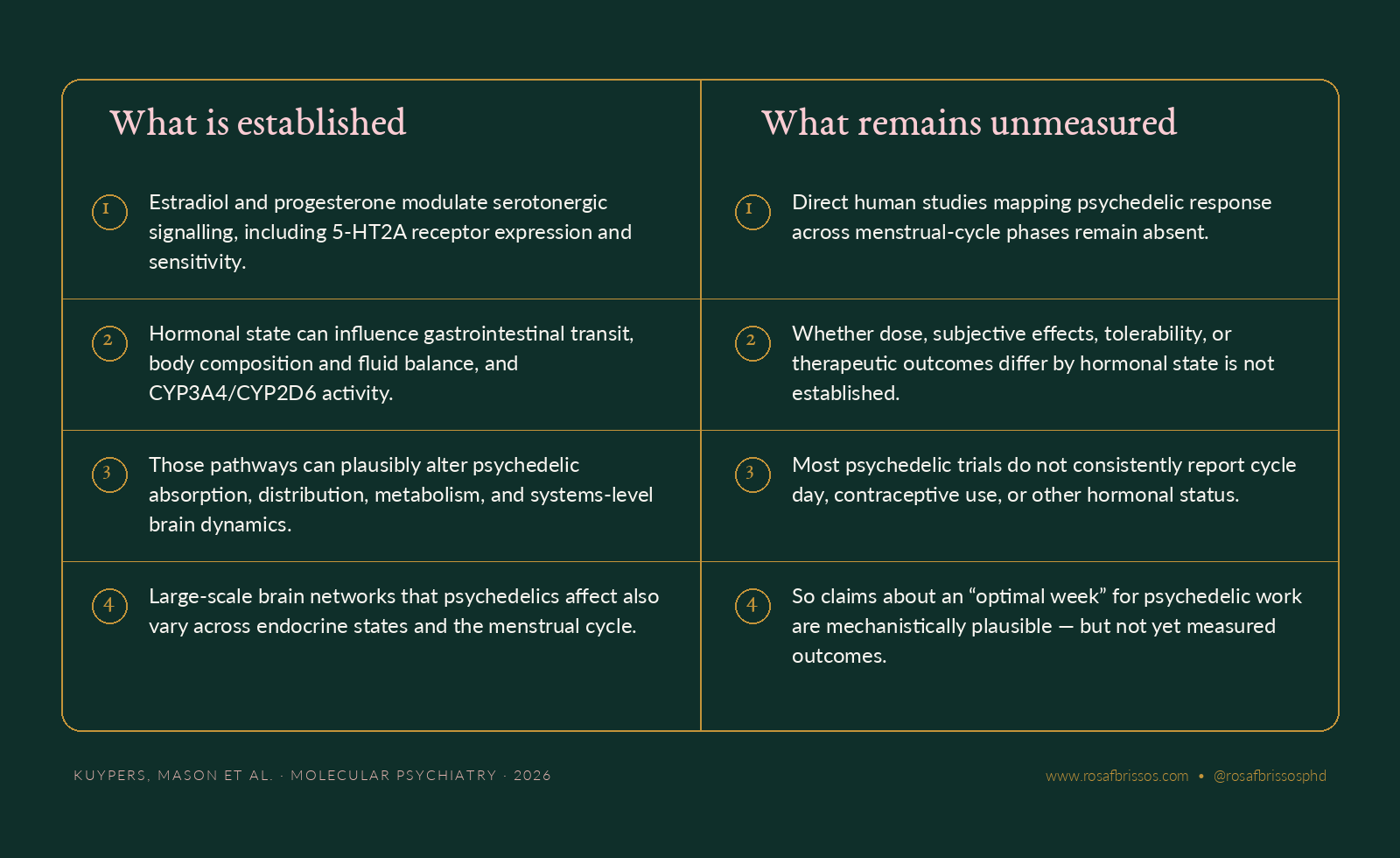 In August 2026, Kuypers, Mason and colleagues published a review in Molecular Psychiatry synthesising the clinical, preclinical and neuroimaging evidence on how female sex hormones affect psychedelics’ efficacy and tolerability (3). They lay out the full plausible machinery:
- Hepatic metabolism. Sex hormones modulate cytochrome P450 enzymes — including CYP3A4 and CYP2D6 — which are key pathways in the biotransformation of LSD and psilocin.
- Gastrointestinal physiology. Gastric pH and transit time affect onset and time-to-peak for anything taken orally.
- Tissue distribution. Body composition and fluid balance alter how a lipophilic compound distributes.
- Receptor availability. 5-HT2A binding shifts across the cycle and across the reproductive lifespan.
- Network-level effects. The large-scale brain networks that reorganise under a psychedelic — default mode, salience, prefrontal-limbic — are also modulated by hormonal state.
Every mechanistic reason to expect this matters.
And then the review states the finding that reorganised how I talk about this with clients:
Not contested. Not mixed. Absent (3).
Most trials do not report what cycle day a participant was on. Many never recorded it. Pregnancy, lactation and hormonal contraception are frequently reasons to exclude a woman from a study rather than reasons to design one.
What the evidence does not support
There is a very popular version of this article, and I am not writing it. That version gives you an optimal week, tells you to book your breakthrough on day 9 and avoid day 25, and sells you a protocol. It is confident, specific, and it converts extremely well.
It is also unsupported and fails in a specific way worth understanding.
The clean story is: high oestrogen means more receptive; low oestrogen means less receptive. It is intuitive, and it does not survive contact with the literature. Kuypers and colleagues report higher 5-HT2A availability in low-progesterone states (3) — which is a different axis altogether, not a restatement of the oestrogen story. The preclinical work is messier still: in some paradigms low-oestrogen females show more response rather than less, which breaks the tidy model outright.
So the honest position is that the direction of the effect is not settled, let alone its size or a calendar.
When someone hands you a protocol with day numbers on it, they did not get those numbers from a trial. They extrapolated from a mechanism and supplied their own confidence. That is the gap you are being sold.
The one human study on emotional learning — and its limits
The closest relevant human evidence sits slightly to the side of psychedelics, in fear learning — which matters because fear extinction is one of the processes therapeutic work depends on.
In 2015, Hwang and colleagues, working in Mohammed Milad’s group at Massachusetts General Hospital, ran a two-day fear-conditioning and extinction protocol in an MRI scanner with 37 men and 48 women (4). The women were divided by oral contraceptive use and, among naturally cycling participants, by high or low oestradiol — groups of sixteen.
Women with higher oestradiol levels showed greater activation across the fear network — insula, cingulate, amygdala, and hippocampus — during conditioning, extinction, and recall.
That is a real finding, and I want to be careful about what it is.
It is activation, measured on a scan, in groups of sixteen. Greater signal in a brain region is not the same thing as better learning, and it is certainly not a treatment schedule. The study was designed to demonstrate that hormonal status must be documented in fear-learning research — and it did so convincingly. It was not designed to tell you when to book a session, and it cannot.
Anyone converting that result into a calendar is selling you the distance between those two sentences.
What the field says about itself
One more, because it is the most direct answer to “surely someone knows.”
In July 2024, a review in Endocrinology by Shadani, Conn, Andrews and Foldi assessed what is known about sex differences in psychedelic action (5). Their conclusion is careful and, read properly, quite bleak: sex-specific effects remain unclear. The animal studies that build the mechanistic account predominantly use one sex. The human studies are not designed to detect the interaction.
Two independent reviews in Endocrinology and Molecular Psychiatry arrive at the same conclusion: mechanistically plausible, clinically relevant, and systematically uncharacterised.
What to do instead
The absence of data does not leave you with nothing. It leaves you with two things.
Keep the record. Four columns: cycle day, sleep, what you could hold that day, what you couldn’t. Six months of that is not a study — no control group, no publication, no generalisability. It is also the only dataset that exists on you, and on this specific question, it already has more than the field does. If you are doing preparation or integration work, add session dates to it. Patterns that are invisible over three weeks become legible over six months.
Ask the questions. Before any altered-states work, or any work with your nervous system, a competent practitioner should be asking:
- Where are you in your cycle?
- What medication or contraception are you taking?
- Has any practitioner asked you either of those, in this context, before?
Most people answer no to the third.
That “no” is the real finding of this article. Not a protocol, not an optimal week — the fact that a variable with this much mechanistic plausibility behind it is routinely not recorded, not asked about, and not accounted for.
If the person guiding you has never raised it, that is not a small gap. It tells you something about how they think, and about what else they may not be asking.
If you want a sense of what a session that does ask these questions actually looks like, I have written in detail about what happens in a first session. If you want to check a practitioner more broadly, how to tell whether a practitioner is genuinely trauma-informed covers the rest.
And if you’d rather just start: The First Hour is sixty minutes, one-to-one, €35. The rate is low while I am certifying in Compassionate Inquiry, and it rises at certification — I would rather tell you that plainly than dress it up as a limited offer.
Frequently asked questions
Does the menstrual cycle affect psilocybin?
Almost certainly, on mechanistic grounds — oestradiol and progesterone modulate 5-HT2A receptor availability and the liver enzymes that metabolise psilocin. But direct human data on psychedelics across the cycle remain absent, so the size and direction of the effect are not established.
Should I schedule a psychedelic session at a certain point in my cycle?
There is no evidence base for an optimal cycle window in humans. Anyone offering you specific day numbers is extrapolating from mechanism, not reporting a trial result.
Does hormonal birth control change how psychedelics work?
It changes the hormonal context substantially — combined oral contraceptives suppress natural cyclicity and maintain steadier hormone levels. Whether that changes psychedelic response has not been directly tested. Hormonal contraception is frequently an exclusion criterion in trials rather than a variable that gets studied.
Why weren’t women studied properly in psychedelic trials?
The exclusion predates psychedelic research. A 2010 audit found that male-only animal studies outnumbered female-only ones 5.5 to 1 in neuroscience, on the grounds that females were more variable and too troublesome for routine inclusion. That belief was tested in the same review and found to be without foundation.
What should I tell a practitioner about my cycle?
Where you are in your cycle, what medication and contraception you take, and any history of cycle-linked mood changes. A competent practitioner should ask without being prompted.
Is it safe to do this work during my period?
There is no evidence that any cycle phase is unsafe for nervous-system or integration work. Pain sensitivity and stress reactivity vary across the cycle, which may change how the session feels rather than whether it is safe.
References
(1) Beery, A. K.; Zucker, I. Sex Bias in Neuroscience and Biomedical Research. Neurosci. Biobehav. Rev. 2010, 35 (3), 565–572. DOI: 10.1016/j.neubiorev.2010.07.002.
(2) Zucker, I.; Prendergast, B. J. Sex Differences in Pharmacokinetics Predict Adverse Drug Reactions in Women. Biol. Sex Differ. 2020, 11 (1), 32. DOI: 10.1186/s13293-020-00308-5.
(3) Kuypers, K. P. C.; Mason, N. L.; Carlier, A.; Totomanova, I.; Haijen-Bongers, E. C. H. M. Psychedelics and Women’s Mental Health: The Effects of Female Sex Hormones on Psychedelics’ Efficacy and Tolerability. Mol. Psychiatry 2026. DOI: 10.1038/s41380-026-03801-2.
(4) Hwang, M. J.; Zsido, R. G.; Song, H.; Pace-Schott, E. F.; Miller, K. K.; Lebron-Milad, K.; Marin, M.-F.; Milad, M. R. Contribution of Estradiol Levels and Hormonal Contraceptives to Sex Differences within the Fear Network during Fear Conditioning and Extinction. BMC Psychiatry 2015, 15, 295. DOI: 10.1186/s12888-015-0673-9.
(5) Shadani, S.; Conn, K.; Andrews, Z. B.; Foldi, C. J. Potential Differences in Psychedelic Actions Based on Biological Sex. Endocrinology 2024, 165 (8), bqae083. DOI: 10.1210/endocr/bqae083.
Rosa F. Brissos, PhD, is a medicinal chemist and holistic therapist specialising in nervous system regulation, somatic trauma work, and preparation and integration of altered states. Based in Portugal. Working internationally.