
If you’ve done years of work on your mental health and still feel anxious, flat, or stuck, there’s a question almost no one will ask you: how is your gut?
It sounds unrelated. It isn’t. As a biochemist who spent years studying this system (and many more living its consequences), I can tell you the gut-brain axis is one of the most underappreciated frontiers in mental health. Your mood does not live only in your head — a surprising amount lives in your gut, and once you understand the mechanism, a lot of things that felt like personal failings start to look like solvable biology.
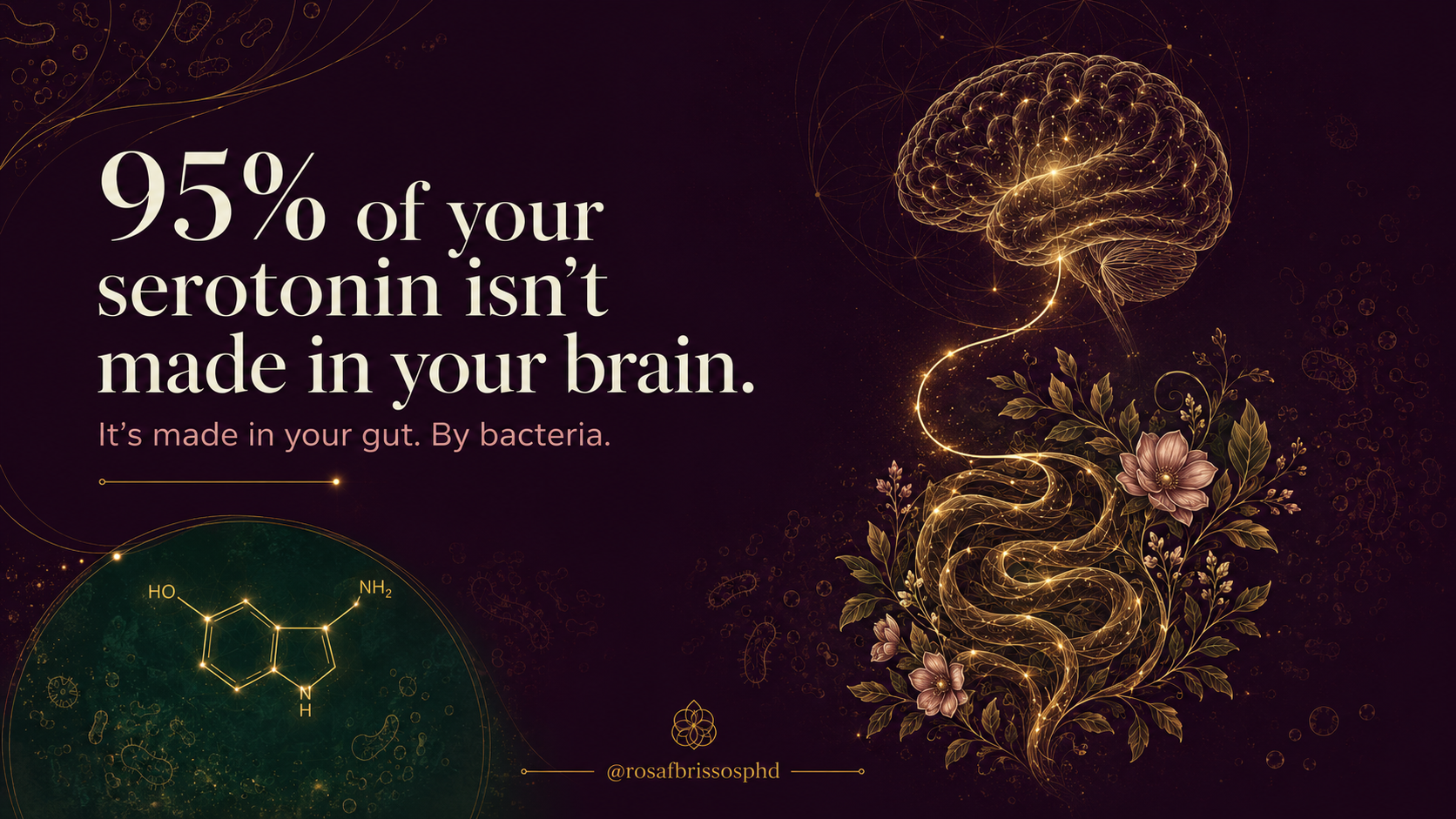 95% of your serotonin is made in your gut. ~95% of your serotonin is produced in your gastrointestinal tract, by cells working with your gut bacteria. [1] Serotonin is the neurotransmitter most associated with mood and the target of many antidepressants. Those microbes — ~38 trillion — also produce GABA, influence dopamine precursors, and generate short-chain fatty acids that regulate brain inflammation. Your microbiome is functionally a pharmacy.
Your “second brain” and the vagus highway. Your gut’s enteric nervous system has ~500 million neurons. It communicates with your brain primarily via the vagus nerve, and more than 80% of that signaling runs bottom-up, gut to brain. [1] Your gut continuously reports its status; your brain largely receives. This is why gut condition shapes emotional regulation and mood.
The study that proved cause, not correlation. Researchers gave animals Lactobacillus rhamnosus, which reduced anxiety/depression-like behavior, normalized stress hormones, and altered brain GABA receptors. [2] Then they cut the vagus nerve, and the effect disappeared entirely. In humans, Bifidobacterium longum NCC3001 reduced anxiety and normalized amygdala responses on imaging. [3]
How stress and trauma damage the gut. Stress hormones alter motility and immune function, and increase permeability (“leaky gut”), allowing endotoxin (LPS) to enter the bloodstream and trigger neuroinflammation. [4] Social stress can shift microbiome composition within hours. [5] Stress harms the gut; a harmed gut worsens stress and mood.
The good news: the gut is changeable. The SMILES trial — a Mediterranean-diet intervention for major depression — produced 32% remission vs 8% in controls. [6] High-fiber, diverse, minimally processed eating increases beneficial SCFAs that strengthen the gut barrier and reduce neuroinflammation. Restoring vagal tone improves the gut, and improving the gut improves vagal signaling.
If your relationship with food or mood has felt like a discipline problem, consider it may be a nervous-system and gut story — far more workable, because biology responds to intervention. Start with The First Hour.
FAQ
- Can gut health affect depression and anxiety?
Yes, ~95% of serotonin is made in the gut, bacteria produce GABA, and probiotics have reduced anxiety and normalized brain fear-responses [3]. The vagus carries these signals gut→brain. - How does the gut communicate with the brain?
Primarily the vagus nerve (>80% bottom-up), plus immune signaling and bacterial metabolites — the gut-brain axis [1]. - Cause or just correlation?
Lactobacillus rhamnosus reduced anxiety; cutting the vagus nerve abolished the effect [2]. - Can diet improve mental health?
SMILES trial: 32% remission vs 8% [6]. - Why do I crave food when stressed?
Stress dysregulates the nervous system and gut together; emotional eating is a dysregulated system reaching for the fastest signal of safety, not a willpower failure.
REFERENCES
[1] Cryan, J. F.; et al. The Microbiota-Gut-Brain Axis. Physiol. Rev. 2019, 99 (4), 1877-2013. DOI: 10.1152/physrev.00018.2018
[2] Bravo, J. A.; et al. Ingestion of Lactobacillus strain regulates emotional behavior via the vagus nerve. PNAS 2011, 108 (38), 16050-16055. DOI: 10.1073/pnas.1102999108
[3] Pinto-Sanchez, M. I.; et al. Probiotic Bifidobacterium longum NCC3001 Reduces Depression Scores and Alters Brain Activity. Gastroenterology 2017, 153 (2), 448-459. DOI: 10.1053/j.gastro.2017.05.003
[4] Kelly, J. R.; et al. Breaking down the barriers: the gut microbiome, intestinal permeability and stress-related psychiatric disorders. Front. Cell. Neurosci. 2015, 9, 392. DOI: 10.3389/fncel.2015.00392
[5] Bailey, M. T.; et al. Exposure to a social stressor alters the structure of the intestinal microbiota. Brain Behav. Immun. 2011, 25 (3), 397-407. DOI: 10.1016/j.bbi.2010.10.023
[6] Jacka, F. N.; et al. A randomised controlled trial of dietary improvement for adults with major depression (the ‘SMILES’ trial). BMC Med. 2017, 15, 23. DOI: 10.1186/s12916-017-0791-y