
 You have heard the phrase. It is on book covers, in workshop titles, in the mouth of every second practitioner. Trauma is stored in the body.
It is also seldom defined.
And because it is never defined, it does two opposite things at once. It gives people an enormous relief — so I am not imagining this — and it hands them a picture that is, taken literally, wrong. The picture is of memory filed away in muscle. Grief in the hips. Anger in the jaw. Something lodged in the tissue like a splinter, waiting to be dug out by the right pair of hands.
I am a medicinal chemist by training. I use somatic work daily, and I think the phrase is pointing at something real. But the literal version is not what the evidence describes, and the gap between the phrase and the mechanism is where a great deal of money changes hands.
So here is the precise version.
The short answer
Nothing is filed in your shoulder. What changed is the prediction, not the tissue.
Your nervous system runs a continuously updated model of how dangerous your situation is. That model is built from what has already happened to you. It then shapes what you feel now — including pain, tension, and the physical alarm that arrives before you have consciously decided anything is wrong.
Nothing is stored. Something was learned. And what was learned is a forecast.
That distinction sounds academic. It is the whole thing. A splinter has to be extracted. A forecast can be updated.
Pain is an output, not a reading
Start with the part most people have backwards.
Pain feels like a measurement. Something is damaged, a signal travels up, you feel it in proportion. That model is intuitive, and it is not how the system works.
In 1965 Melzack and Wall proposed that signals from the body are gated on their way up — amplified or suppressed depending on other inputs, including what the brain concludes about the situation.[1] Six decades of work have refined that architecture rather than replaced it.
Pain is an output. It is what your brain produces after it has evaluated how much danger you are in. Tissue signals are one input into that judgement. They are not the verdict.
This is why a person can be seriously injured in an emergency and feel almost nothing until they are safe. It is why the same stimulus hurts more when you are frightened, exhausted, or alone. The volume knob is real, it is not under conscious control, and it is doing a job.
The 85% problem
Now the number that should be far better known than it is.
In the chronic back pain literature, approximately 85% of cases are classed as primary — meaning no peripheral cause can be identified.[2]
Not “we did not look carefully enough.” Looked, and there is not one.
Consider what that does to the person in the scanner. They are told the images are unremarkable. What they hear is: there is nothing wrong with you. And because the only two explanations anyone has ever offered them are your spine or your head — and the first has just been crossed off — they go home and quietly conclude they have been exaggerating.
That conclusion is wrong. It is also entirely reasonable, because they were handed a two-item menu for a three-item problem.
There are three categories, not two
This is the part almost nobody is told.
Nociceptive pain. Tissue is damaged or threatened. The alarm is working exactly as designed. A broken wrist, a torn ligament, a burn.
Neuropathic pain. Damage or disease in the nerve itself. A problem with the wire, not with the room it reports on.
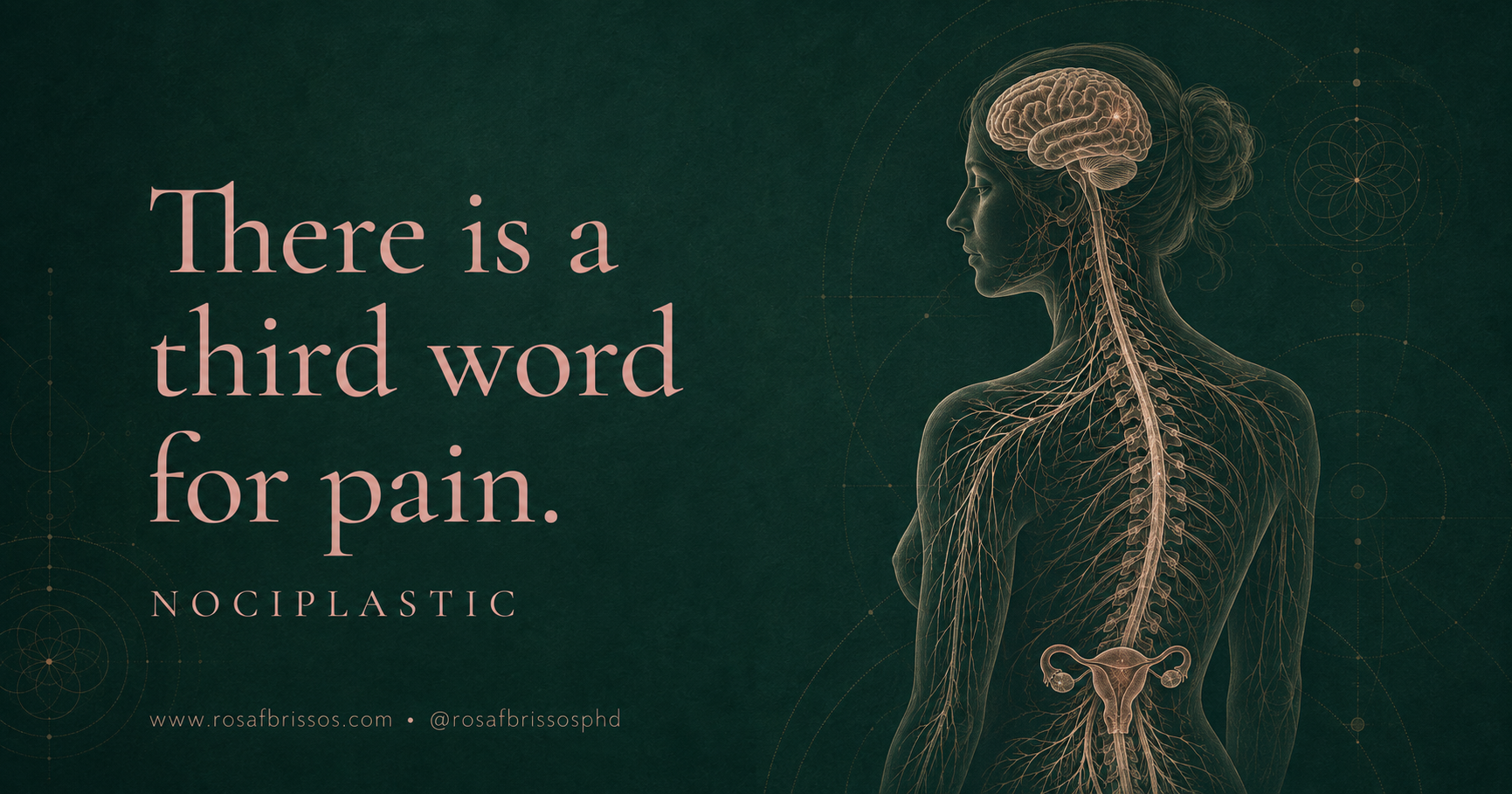
Nociplastic pain. Pain arising from altered nociception, with no clear evidence of tissue damage and no evidence of nerve disease.[3]
Real pain. Real mechanism. Nothing to point at on a film.
That third category is not a euphemism invented to console people whose scans came back boring. An international group published formal clinical criteria and a grading system for it in 2021.[3] In 2024, a consortium of thirty-six clinicians across thirteen countries and twenty-nine institutions published consensus recommendations for distinguishing the three in low back pain.[4]
And I am going to tell you the half you will not usually be sold. In that same 2024 paper, the authors wrote that their recommendations “are not ready to be implemented in clinical practice until additional evidence is generated.”
Both things are true. There is a name for what you may have, and the people who named it are still working out how to use it clinically. You are entitled to hold those together rather than being handed the first as a cure.
So is it “in the body” or “in the head”?
Neither, and the question itself is the problem.
“In the head” is used to mean not real. Nothing in the above says the pain is not real. It says the pain is being produced rather than reported — which is a statement about mechanism, not about legitimacy.
If you want the version that is difficult to argue with: researchers scanned people with fibromyalgia (n=26) and people with rheumatoid arthritis (n=31), calibrating the pressure individually so that both groups reported the same pain intensity — 50 on a 100-point scale. Same number out of their mouths. The brains were doing measurably different things.[5]
Small study, and I would rather say so than have you find out. But the direction matters: real, and not caused by damage, is a different physical process, and it is visible.
Where the popular version goes wrong
Two specific claims deserve retiring.
“Trauma lives in a specific body part.” There is no established map assigning emotions to anatomical regions. People do experience reliable, personal patterns — mine are the shoulder and the hip — and those patterns are informative about that person. They are not a shared code you can look up. A practitioner who tells you your grief is in your left hip is not reading evidence.
“You have to release it.” The language of release implies a stored substance with a volume. If what you are dealing with is a learned prediction, the useful verb is not release. It is update — and updating requires new experience, repeated, in conditions safe enough for the system to accept the data.
The evidence that it can change
This is the part that should have made more noise than it did.
In a randomised trial of 151 adults with chronic back pain — average duration ten years — 33 of 50 participants (66%) who received pain reprocessing therapy were pain-free or nearly pain-free after treatment, compared with 20% on placebo injection and 10% in usual care. Effects held at one-year follow-up.[2]
The limits, stated plainly: baseline pain was low-to-moderate (mean 4.10 out of 10), all participants had primary chronic back pain, and this is one trial.
But the follow-up analysis is where it gets interesting for our question. Participants were asked, in their own words, to list the top three causes of their pain. At baseline, 10% of those answers referenced mind or brain processes. After treatment, that rose to 51% in the treated group versus 8% in controls — and the change in that list mediated the pain outcome a year later.[6]
Not the sessions. The list.
That is as close to a direct measurement of “the prediction changed” as the literature currently offers. The mediation sits at P = .05, which is exactly on the line rather than comfortably past it, and the sample was 89% white. I would rather you have those numbers from me than find them later and wonder what else was smoothed over.
What to do on Tuesday
Take sixty seconds and do the thing the trial did.
Write down the top three causes of your pain. In your own words. Do not tidy them.
Then look at what you wrote — not to judge it, but to notice which category your own mind reached for first. Structural? Neurological? Or something about your life, your history, your state?
Most people find their list is entirely structural, and most people have never been asked. The value is not in getting the “right” answer. It is in discovering that you had a model you never examined.
What this does not mean
It does not mean stop investigating physical causes. Get the scan. Rule things out. Nociceptive and neuropathic pain are real and common and require different treatment.
It does not mean your pain is a choice, or that you caused it by thinking wrongly. Predictive systems are not under voluntary control. That is precisely why willpower does not fix this.
And it does not mean any practitioner using the phrase is selling you something. Most mean well. But when you next hear trauma is stored in the body, it is entirely fair to ask: stored how, and where, and what would change it? If the answer is a confident anatomical map, you have learned something useful about who you are talking to.
Frequently asked questions
Is trauma really stored in the body?
Not in the literal sense of memory being filed in tissue. What the evidence supports is that past experience updates the nervous system’s predictive model, and that model shapes present sensation — including pain, tension and physical alarm.
Why does my body hurt when the scan is clean?
Approximately 85% of chronic back pain is classed as primary, meaning no peripheral cause can be identified.[2] A clean scan rules out one category of cause; it does not mean nothing is happening. Nociplastic pain is real pain with no tissue damage and no nerve disease.[3]
Is nociplastic pain the same as psychosomatic pain?
No. “Psychosomatic” is widely used to imply not real. Nociplastic pain is a formally defined mechanistic category with published clinical criteria and observable differences in central processing.[3][5]
Can this kind of pain actually improve?
In one randomised trial, 66% of participants receiving pain reprocessing therapy were pain-free or nearly pain-free after treatment, with effects maintained at one year.[2] That is one trial in a specific population, and the consensus guidance for phenotyping is explicitly described by its own authors as not yet ready for routine clinical implementation.[4]
How do I find someone who understands this?
Ask what happens when they get it wrong, and ask them to name the limits of their own approach. A practitioner who can state where their evidence is thin is telling you something a testimonial cannot.
If you would like to read your three causes back to someone who will not flinch at them, that is what The First Hour is for — a single 60-minute session, €35 while I am certifying in Compassionate Inquiry, rising when I qualify. If you already know you want to go further, The Window is the 90-minute session with a follow-up placed inside the neuroplasticity window. More on how I work is on the Approach page.
References
- Melzack, R.; Wall, P. D. Pain Mechanisms: A New Theory. Science 1965, 150 (3699), 971–979. DOI: 10.1126/science.150.3699.971.
- Ashar, Y. K.; Gordon, A.; Schubiner, H.; Uipi, C.; Knight, K.; Anderson, Z.; Carlisle, J.; Polisky, L.; Geuter, S.; Flood, T. F.; Kragel, P. A.; Dimidjian, S.; Lumley, M. A.; Wager, T. D. Effect of Pain Reprocessing Therapy vs Placebo and Usual Care for Patients With Chronic Back Pain: A Randomized Clinical Trial. JAMA Psychiatry 2022, 79 (1), 13–23. DOI: 10.1001/jamapsychiatry.2021.2669.
- Kosek, E.; Clauw, D.; Nijs, J.; Baron, R.; Gilron, I.; Harris, R. E.; Mico, J.-A.; Rice, A. S. C.; Sterling, M. Chronic Nociplastic Pain Affecting the Musculoskeletal System: Clinical Criteria and Grading System. Pain 2021, 162 (11), 2629–2634. DOI: 10.1097/j.pain.0000000000002324.
- Nijs, J.; Kosek, E.; Chiarotto, A.; Cook, C.; Danneels, L. A.; Fernández-de-Las-Peñas, C.; Hodges, P. W.; Koes, B.; Louw, A.; Ostelo, R.; Scholten-Peeters, G. G. M.; Sterling, M.; et al. Nociceptive, Neuropathic, or Nociplastic Low Back Pain? The Low Back Pain Phenotyping (BACPAP) Consortium’s International and Multidisciplinary Consensus Recommendations. Lancet Rheumatol. 2024, 6 (3), e178–e188. DOI: 10.1016/S2665-9913(23)00324-7.
- Sandström, A.; Ellerbrock, I.; Löfgren, M.; Altawil, R.; Bileviciute-Ljungar, I.; Lampa, J.; Kosek, E. Distinct Aberrations in Cerebral Pain Processing Differentiating Patients with Fibromyalgia from Patients with Rheumatoid Arthritis. Pain 2022, 163 (3), 538–547. DOI: 10.1097/j.pain.0000000000002387.
- Ashar, Y. K.; Lumley, M. A.; Perlis, R. H.; Liston, C.; Gunning, F. M.; Wager, T. D. Reattribution to Mind-Brain Processes and Recovery From Chronic Back Pain: A Secondary Analysis of a Randomized Clinical Trial. JAMA Netw. Open 2023, 6 (9), e2333846. DOI: 10.1001/jamanetworkopen.2023.33846.
